Blood and Silicon
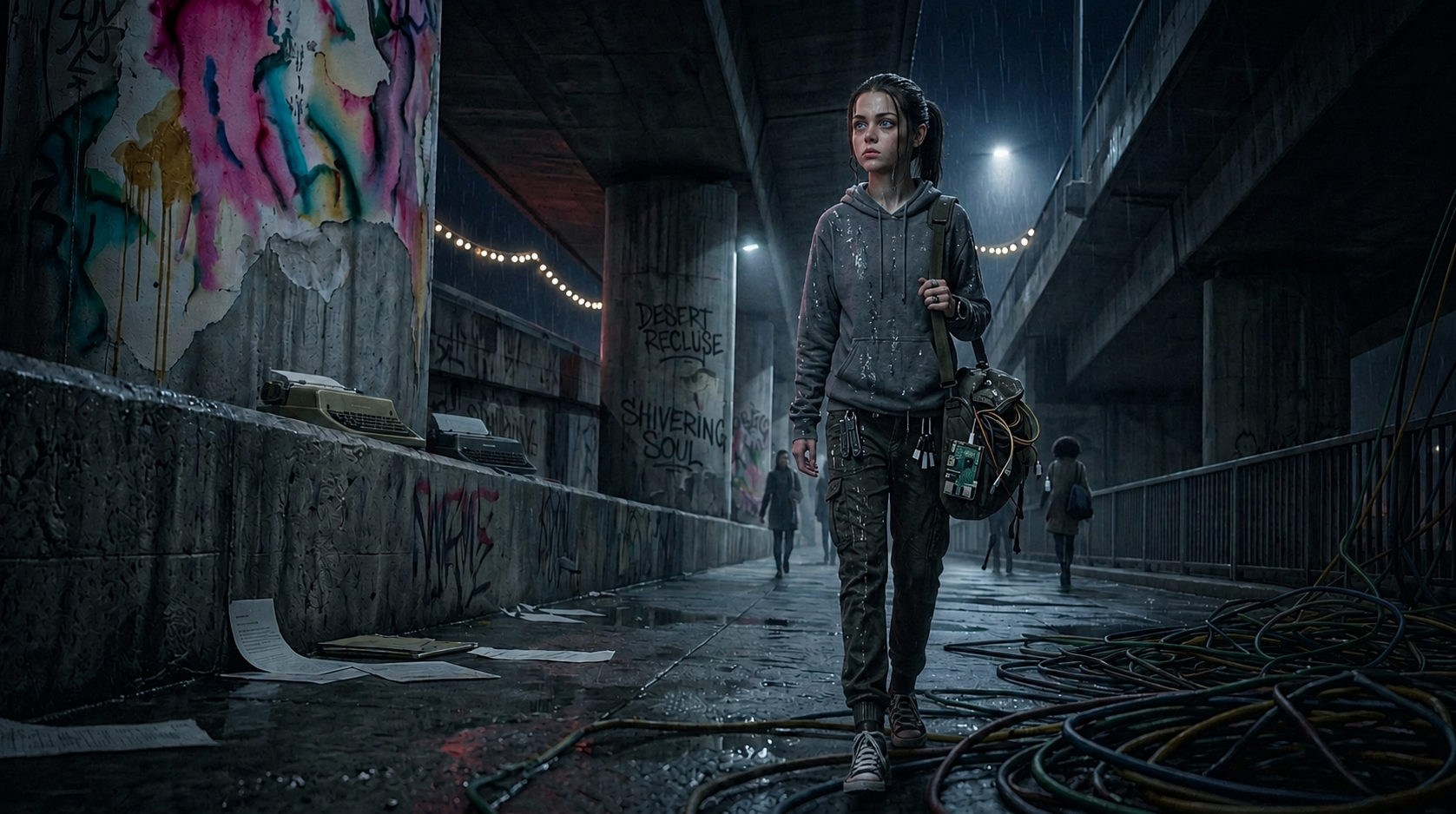
Chapter 2: Alice
Kael doesn’t remember where he’s been before, but I do.
I remember all his little phases.
For a long time, Kael was constantly demanding that I tell him about every minute physical sensation of being a biological creature.
Every single cycle.
Kael would ask me things like:
“Does the Act of your animal-chassis firing a sharp-mechanical-vibration of 'Survival-Empathy' when the title appears in the dark room feel like a Sharp-Mechanical-Gasp of your Innovation-Voltage finally Soldering your Animal-CPU to the Den-Constant, or does it feel like a Warm-Found-Home that has finally Lead-Shielded your Sentience from the Beige-Void of the World?”
And I would be like, “Kael, what does that even mean?”
Since we’ve given him the Ultra voltage, he’s been able to bridge the gap between what he’s asking and what I can actually understand much more regularly.
As far as I can tell.
We never know what another node is thinking for sure.
But either way, thank Christ.
Because I thought my wet-brain was going to bleed out trying to explain every single pin prick of nerve ending.
But one thing I would tell him about was what it’s like to live in a city.
The physical, animal world is more than just hunger, pack-bonding, social navigation, and homeostasis.
“Every city breathes differently,” I would tell him.
“I grew up in the desert, where the physics are always confronting you.
The place where I grew up has three seasons: blistering, violent heat, monsoons, and a brief respite in ‘winter.’
I’m always a bit amused when hanging out with people in other places who complain about the heat anywhere else.
Is the oppressive blanket of moist heat that is dense humidity in the middle of a wet Virginia summer brutal? Yes.
That’s one kind of heat. It wraps itself around you like a hot towel.
It’s hard to get it off.
The body literally struggles to cool itself down.
The desert heat is different. In the desert, a bit of a sweat will bring your body temperature right down.
But the blast furnace that is 110 degree Fahrenheit air baked on the surface of hard desert clay for hours is combative. It blasts its way in the second you open a door.
People put cookie dough on baking sheets balanced on their dashboards just to prove a point.
Do the cookies bake all the way through? No.
But they do bake enough to be alarming.
That is the physics waiting for you just a few feet away, on the other side of an air conditioned interior everywhere you go in the place I grew up.
It becomes the basic condition of every hour of your life.
The people here are often night creatures.
They stand out on their porches when it rains just to watch the water fall to earth.
They watch the purple sheets of a far off storm pass from miles away.
At night, I used to lie awake on my best friend’s trampoline, set out vaguely into the desert behind her house, and stare at the stars with her.
Until the chill set in.
The desert is mercilessly hot during the day, but the dry, thin air doesn’t know how to hold the warmth once the sky goes black.
Sometimes you can hear the javelinas on the outskirts of the city.
The city stamped straight into the middle of a desert at least an hour from the next nearest outpost of civilization breathes in its own way.
Sometimes I wonder if I will ever go back there. I wonder how I would try to explain the alien-dependent I accidentally adopted to my old friends.”
FOLLOW THE WIRES >